
How B2B Distribution Differs from D2C Fulfilment in the UK
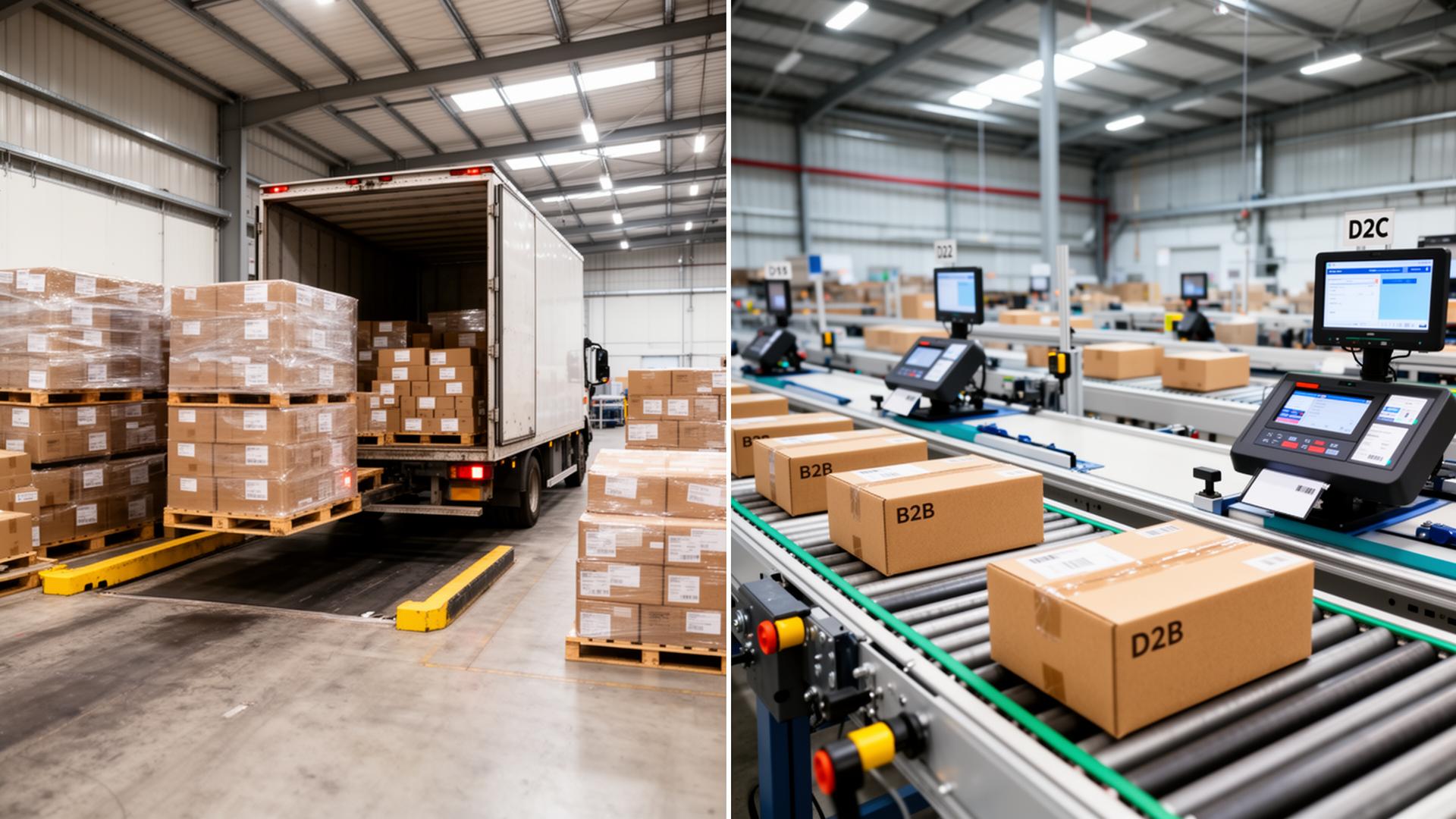
Two Models, One Warehouse — Very Different Operations
If your business sells both to other businesses (B2B) and directly to consumers (D2C), you are operating two fundamentally different logistics models. While both involve storing goods and shipping them to customers, almost everything else — order profiles, delivery methods, compliance requirements, and cost structures — differs significantly.
Understanding these differences is essential for choosing the right warehouse and logistics partner, and for pricing your products accurately across both channels.
The Core Differences
Order Size and Composition
The most obvious difference is the size of each order.
B2B orders typically involve:
- Full or mixed pallets
- Case quantities (12, 24, 48 units)
- Fewer orders per day, but higher value per order
- Regular, recurring orders from the same customers
D2C orders typically involve:
- 1 to 3 individual items per order
- High order frequency (potentially hundreds or thousands per day)
- Each order goes to a unique address
- One-off purchases from a wide customer base
This difference has profound implications for warehouse layout, picking processes, and staffing. A fulfilment centre optimised for D2C will have extensive shelving and bin locations for single-item picking, while a B2B distribution operation needs space for pallet assembly and loading.
Delivery and Transport
B2B delivery:
- Pallet networks (Palletways, TPN) or dedicated vehicles
- Pre-booked delivery slots at the customer's warehouse or store
- Loading bay access required
- Proof of delivery with signature
- Lead times of 2–5 working days are standard
D2C delivery:
- Parcel carriers (Royal Mail, DPD, Evri, Yodel)
- Delivered to residential addresses
- Next-day or 2-day delivery expectations
- Tracking provided to the end consumer
- Failed delivery attempts and redelivery logistics
The carrier relationships, rate structures, and operational processes are entirely different. A warehouse that excels at loading pallets onto curtain-siders may not be efficient at processing 500 individual parcels through a sorting system.
Compliance and Labelling
B2B compliance can be extremely demanding, particularly when supplying major retailers:
- GS1 barcode labelling on every case and pallet
- SSCC (Serial Shipping Container Code) labels for pallet tracking
- Advance Shipping Notices (ASNs) sent electronically before delivery
- Specific pallet configurations (stacking patterns, maximum heights, wrapping standards)
- Retailer-specific packaging requirements
Non-compliance typically results in chargebacks — financial penalties deducted from your invoice. These can amount to hundreds of pounds per order and are a significant hidden cost of B2B distribution.
D2C compliance is generally simpler:
- Consumer-friendly packaging
- Correct product labelling (ingredients, safety marks, CE marking where applicable)
- Returns information included in the package
- Compliance with Distance Selling Regulations
Returns Processing
B2B returns are relatively infrequent and are usually handled through commercial negotiation. A retailer might return unsold stock at the end of a season, or reject a delivery that does not meet their specifications.
D2C returns are high-volume and operationally intensive:
- UK online return rates average 20–30% for fashion and 8–12% for general merchandise
- Each return requires inspection, grading, and a decision on restocking, refurbishment, or disposal
- Refund processing timelines are regulated by consumer law
- The cost of returns processing (£2–£5 per item) can significantly affect margins
A warehouse handling D2C fulfilment needs dedicated returns processing space, trained staff, and systems to manage the reverse logistics flow efficiently.
Pricing Models
B2B pricing is typically structured around:
- Per-pallet storage (weekly or monthly)
- Per-pallet or per-case handling for picks and dispatches
- Transport charged per pallet or per delivery
D2C pricing is structured around:
- Per-item or per-bin storage
- Per-order pick and pack charges, plus per-item fees for multi-item orders
- Per-parcel carrier charges based on weight and service level
The unit economics are completely different. A B2B operation might generate £500 in revenue from a single 10-pallet delivery. A D2C operation might need to ship 200 individual parcels to generate the same revenue — each one requiring its own pick, pack, label, and carrier handoff.
Can One Provider Handle Both?
Yes, but not all can. Many warehouses specialise in one model or the other. A facility set up purely for pallet storage and bulk distribution may lack the infrastructure for high-volume single-item picking. Conversely, a fulfilment centre designed for ecommerce may not have the loading bays, pallet racking, or haulage relationships needed for B2B.
The most versatile providers operate hybrid facilities that accommodate both models, often in separate zones within the same warehouse. This allows businesses that sell across both channels to:
- Maintain a single inventory pool rather than splitting stock between locations
- Manage both B2B and D2C orders through one WMS
- Reduce the complexity of coordinating multiple warehouse partners
- Benefit from consolidated pricing across all services
What to Look For in a Dual-Channel Provider
- Separate pick zones for pallet/case picking (B2B) and unit picking (D2C)
- Experience with retailer compliance programmes
- Integration with both B2B order systems (EDI) and ecommerce platforms (Shopify, WooCommerce, Amazon)
- Carrier relationships covering both pallet networks and parcel carriers
- Returns processing capability for D2C volumes
Choosing the Right Model for Your Business
If you currently operate in one channel but are considering expanding to the other, speak to your warehousing provider early. Adding D2C fulfilment to an existing B2B operation — or vice versa — requires planning, system changes, and potentially a different storage layout.
The transition is much smoother if your provider has experience with both models and can advise on the operational and cost implications before you commit.
Get Expert Advice
At The Fulfilment Centre, we handle both B2B distribution and D2C fulfilment from our UK warehouse network. Whether you need pallet deliveries to retailers, parcel dispatch to consumers, or both, we will design an operation that serves all your channels efficiently.
Ready to Optimise Your Fulfilment?
Speak to The Fulfilment Centre Ltd about improving your UK fulfilment.
Get a Quote