
The Complete Guide to Returns Processing in UK Fulfilment
Returns Are a Cost Centre — But They Do Not Have to Destroy Your Margins
UK online return rates average 20–30% for fashion and 8–15% for general merchandise. For many ecommerce brands, returns processing is the most operationally complex and financially draining part of their fulfilment operation.
Yet returns are also an opportunity. Brands that process returns quickly, restock saleable items efficiently, and provide a smooth customer experience turn a pain point into a competitive advantage. Customers who trust your returns process are more likely to buy again.
This guide explains how professional UK fulfilment centres manage returns and how to optimise this critical part of your operation.
The Returns Processing Workflow
Step 1: Returns Authorisation
Best practice is to use a returns management system (RMS) or returns portal that allows customers to:
- Select the items they want to return
- Choose a reason for the return
- Generate a returns label
- Receive a returns tracking number
This gives your warehouse advance notice of incoming returns, speeds up processing, and provides data on why items are being returned.
Step 2: Receiving the Return
When the returned parcel arrives at the warehouse:
- The parcel is scanned against the returns authorisation
- The contents are checked against what was declared
- Any discrepancies are noted (missing items, wrong items returned)
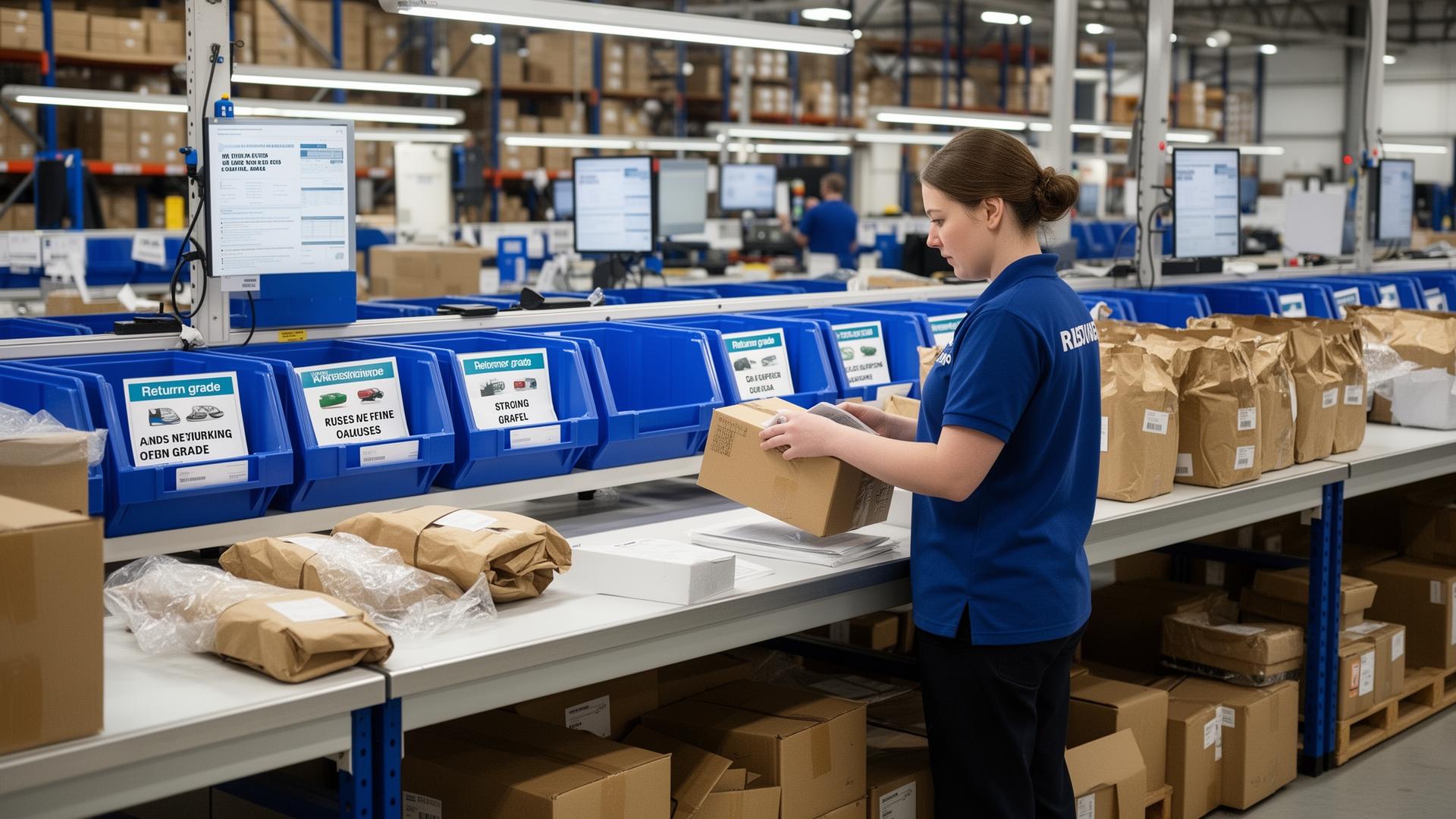
Step 3: Inspection and Grading
Each returned item is inspected and assigned a grade:
| Grade | Condition | Action |
|---|---|---|
| A — As new | Unopened, undamaged, original packaging intact | Restock immediately |
| B — Good | Opened but unused, packaging slightly damaged | Repackage and restock |
| C — Used/minor damage | Signs of use or minor cosmetic damage | Sell as refurbished, discount, or second-quality |
| D — Damaged/defective | Cannot be resold | Return to supplier, recycle, or dispose |
The grading criteria should be agreed between you and your fulfilment provider in advance, with clear documentation and photographs for borderline cases.
Step 4: Restocking or Disposal
- Grade A and B items are returned to saleable inventory and the WMS is updated
- Grade C items are moved to a separate location for resale through secondary channels
- Grade D items are quarantined for supplier return, recycling, or disposal
Speed matters at this stage. Every day a saleable returned item sits unprocessed in a returns cage is a day it is not available for resale.
Step 5: Refund Trigger
Once the return is graded, a refund (or exchange) instruction is triggered. This may be:
- Automatic — the WMS sends a refund notification to your ecommerce platform
- Manual — the warehouse notifies you and you process the refund yourself
Automatic processing is faster and reduces customer complaints about refund delays.
What Does Returns Processing Cost?
Returns processing is labour-intensive and therefore more expensive per item than outbound fulfilment. Costs are typically structured as per-item charges covering receiving and inspection, repackaging, restocking, disposal, and returns labels.
The overall cost of returns processing depends on your return rate, the condition of returned items, and the level of inspection required. At higher volumes, returns become a significant line item that deserves active management.
Reducing Your Return Rate
The cheapest return is the one that never happens. While some returns are inevitable, many are preventable.
Common return reasons and fixes:
- Item not as described — improve product photography, descriptions, and size guides
- Wrong item received — improve pick accuracy (this is a fulfilment quality issue)
- Arrived damaged — improve packaging to protect items in transit
- Changed mind — harder to prevent, but clear product information reduces buyer's remorse
- Sizing issues — add detailed size charts, fit guides, and customer reviews with size feedback
Analyse your return reason data monthly. If a specific SKU has a return rate above 30%, investigate whether the product listing is misleading or the product itself has a quality issue.
Maximising Recovery Value
Not every return is a write-off. A well-managed returns operation recovers maximum value from returned goods.
Recovery strategies:
- Grade A restocking — aim to restock within 24–48 hours of receipt. The longer an item sits unprocessed, the more likely it is to become unsaleable (fashion seasonality, shelf life, etc.)
- Grade B resale — repackage and sell as "open box" or "like new" at a modest discount
- Grade C secondary channels — sell through outlet stores, eBay, or secondary marketplaces
- Grade D supplier returns — if the product is defective, pursue credit from your supplier
- Recycling — for items with zero resale value, responsible recycling is preferable to landfill
Best Practices for Ecommerce Returns
- Make your returns policy clear — publish it prominently on your website. Ambiguity creates customer service enquiries and complaints.
- Provide returns labels — pre-paid labels increase return rates slightly but dramatically improve customer experience and speed up processing.
- Process refunds promptly — UK consumer law requires refunds within 14 days of receiving the return. Aim for 48 hours.
- Track return reasons — build a data set that informs product, marketing, and supplier decisions.
- Set KPIs with your fulfilment provider — agree target turnaround times for returns processing and monitor them.
Professional Returns Processing With TFC
At The Fulfilment Centre, our returns processing service includes inspection, grading, restocking, and detailed reporting. We work with you to define grading standards, maximise recovery value, and provide the data you need to reduce your return rate over time.
Combined with our warehousing and fulfilment services, we handle the complete lifecycle of your products — from container to customer and back again.
Every fulfilment operation is different. We provide tailored quotations based on your stock profile, order volume and distribution model.
Ready to Optimise Your Fulfilment?
Speak to The Fulfilment Centre Ltd about improving your UK fulfilment.
Get a Quote